What Anthropic’s watermark actually changes about AI-assisted content — and what it doesn’t
There’s a particular kind of LinkedIn post that shows up whenever a platform ships something with the letters “AI” in the changelog. Confident tone, no sourcing, a headline built to travel faster than the facts underneath it. Anthropic’s watermark announcement got the full treatment within days: panic on one side, triumphant “I told you so” on the other, and almost nobody pausing to check what the policy actually says.
So here’s what it actually says, and then here’s the part that matters more than the announcement itself.
What happened
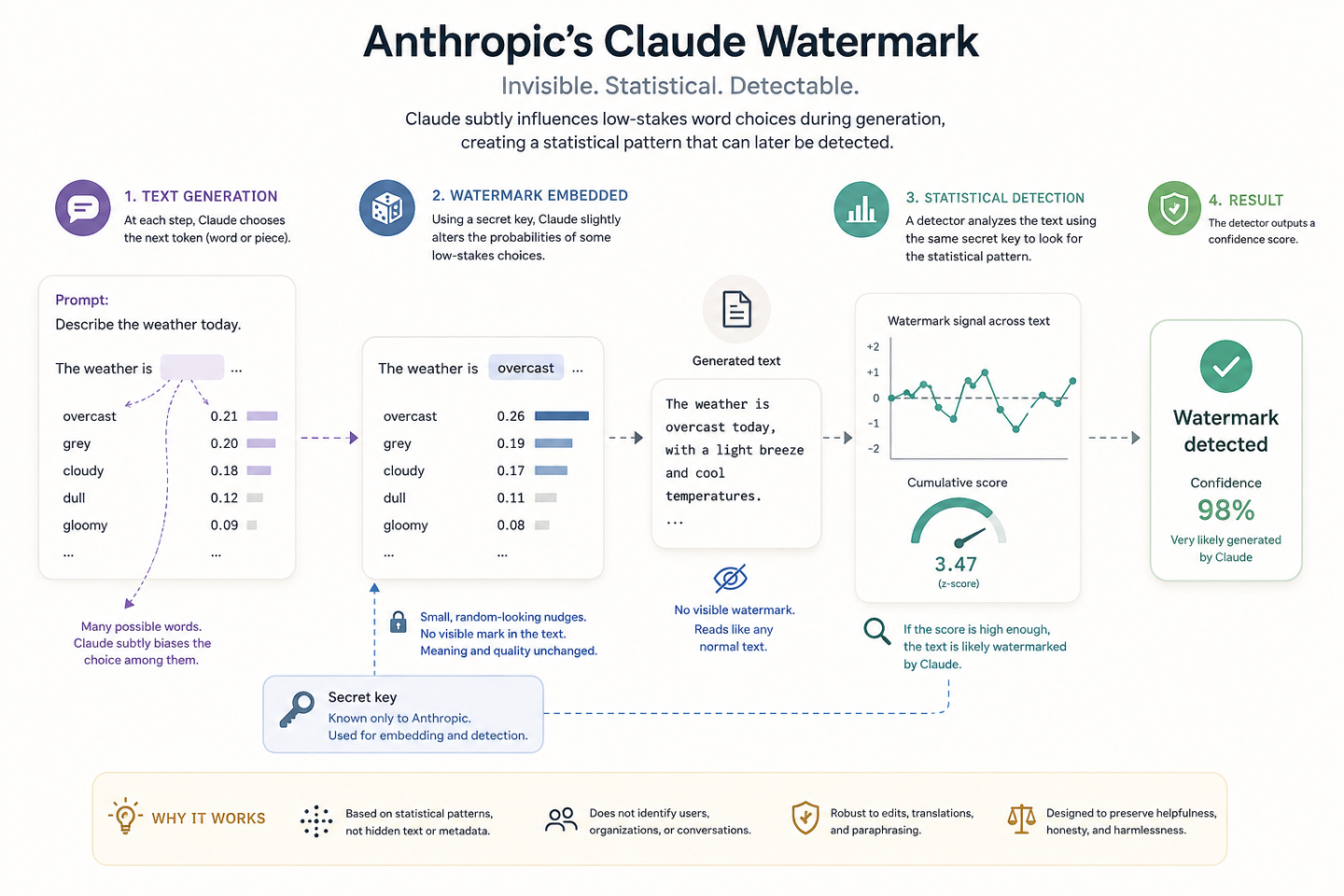
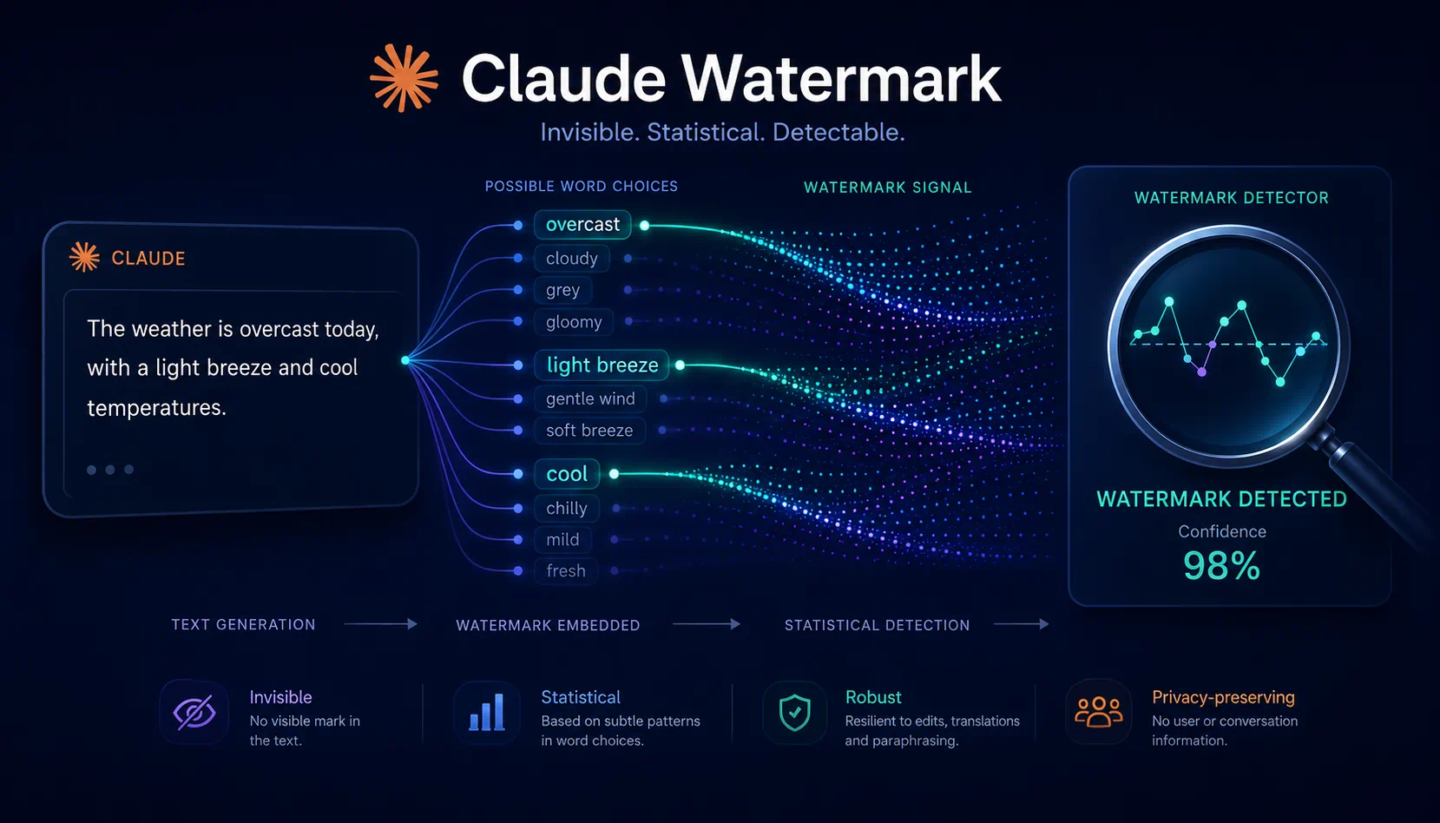
Starting with models released on or after August 2, 2026, Anthropic embeds an imperceptible signal into text generated by Claude. It’s not a hidden character, not metadata bolted onto the file — it’s a pattern built into the word-selection process itself, based on the same SynthID-Text approach Google DeepMind published in 2024. It travels with the text through copy and paste. Light editing probably won’t strip it. A full rewrite, where every word gets replaced, will.
The trigger is regulatory, not competitive. The EU AI Act’s Article 501 transparency rules went live the same day, requiring generative-AI providers operating in the bloc to mark synthetic content in a machine-readable way. Anthropic signed the EU’s Code of Practice on Transparency in July, alongside roughly 190 other signatories — Google, Meta, Microsoft, OpenAI, and more among them. Because there wasn’t yet a reliable way to scope the watermark to EU users only, Anthropic applied it globally. Everyone got the same mark, for a rule that technically only required it for one continent.
That’s the whole event. A compliance mechanism, industry-wide, with no opt-out and no ambiguity about why it exists.
What it doesn’t do
Here’s where most of the commentary went sideways. People read “watermark” and “AI content” in the same sentence and assumed it connects to how Google ranks pages. It doesn’t — not because Google is being generous, but because these are two entirely separate systems run by two separate companies for two separate purposes.
Anthropic’s mark answers one question: did Claude touch this text. It says nothing about whether the text is good, whether a human directed it carefully, or whether it deserves to rank. Google’s search quality guidance has said the same thing since 2023 and hasn’t moved an inch since: the focus stays on the quality of content, not on how it was produced. That’s not a paraphrase of Google’s position — it’s a direct, repeated public statement from Google’s own Search Liaison. There’s no evidence Google reads these watermarks as a ranking signal at all, and given they weren’t built for that purpose, there’s no obvious reason they would start.
What actually gets pages penalized has a name, and it isn’t AI: scaled content abuse. The policy has existed since March 2024, and it hit hard in the March 2026 core update. It targets one pattern, applied to anyone — human teams or AI pipelines — who publish at volume primarily to manipulate rankings rather than to help a reader. Sites that ran that playbook without editorial oversight reported traffic drops of 50 to 80 percent.
Not because a machine caught the watermark. Because the pattern of unsupervised scale is visible whether or not anything is technically watermarked at all.
And the quality gap this exposes was already there before any of this shipped. One analysis of 42,000 blog pages found human-written content roughly eight times more likely to land the top spot than purely AI-generated pages — measured before watermark detection existed as a concept. The watermark didn’t create that gap. It just makes it slightly easier to notice where it came from.
The only real risk is autopilot
If there’s a genuine warning in any of this, it isn’t “stop using AI.” It’s “stop pointing it at a task and walking away.”
The people currently anxious about detection tend to be the ones shipping the most detectable content — generic phrasing, no first-party insight, no editorial pass, the kind of output that reads the same regardless of which tool produced it. The people who keep ranking are doing something structurally different: treating the model as capacity, not as a decision-maker. Direction still comes from a person who knows the subject, checked the claims, and decided what was worth saying.
That’s not a new lesson. It’s the same lesson every production tool has ever taught, just restated for this decade:
the tool doesn’t absolve you of judgment. It amplifies whatever judgment you brought to it, good or absent.
Where the actual leverage is
If origin doesn’t determine quality, and quality is what determines outcome, then the thing worth investing in was never the output layer at all. It’s upstream of it — in how well the instructions going into the model carry the judgment that should shape the result.
Most prompting treats a request as a list of instructions: do this, cover that, keep it under X words. That’s fine for retrieval. It’s thin for anything that depends on tone, confidence, or the kind of intuitive read a person builds after years of doing something — the part of expertise that resists being flattened into a bullet list. I’ve spent a fair amount of time on exactly this problem in my own work: structuring the analog, experiential part of judgment — how confident am I in this claim, where is this speculative versus verified, what’s the tone this deserves — so that it survives being fed into a model instead of evaporating on contact with a plain instruction. The output only carries as much of that judgment as the input made legible in the first place.
That’s the layer nobody was arguing about on LinkedIn, because marking output is visible and easy to have an opinion on. Structuring input well is invisible work. It only shows up later, in whether the result sounds like it came from someone who actually knew what they were talking about.
A watermark I’ll take
None of this reads to me as a threat worth losing sleep over. If anything, I’d count it as a small win.
Somewhere in the last few years, “AI-generated” quietly became something people do while pretending they didn’t — content produced at scale and presented as if it wasn’t, submissions to outlets with explicit no-AI policies, the practice a few platforms have started calling Claudefishing. A watermark doesn’t fix that on its own. But it removes one layer of plausible deniability from a practice that was already contributing to the exact kind of noise everyone claims to be tired of.
I’ll take a little more friction on the low-effort end of the spectrum if it means slightly less infoxication clogging the loop for the rest of us. The work that was already good doesn’t need to hide from a mark that says a tool was involved. It never depended on hiding that in the first place.